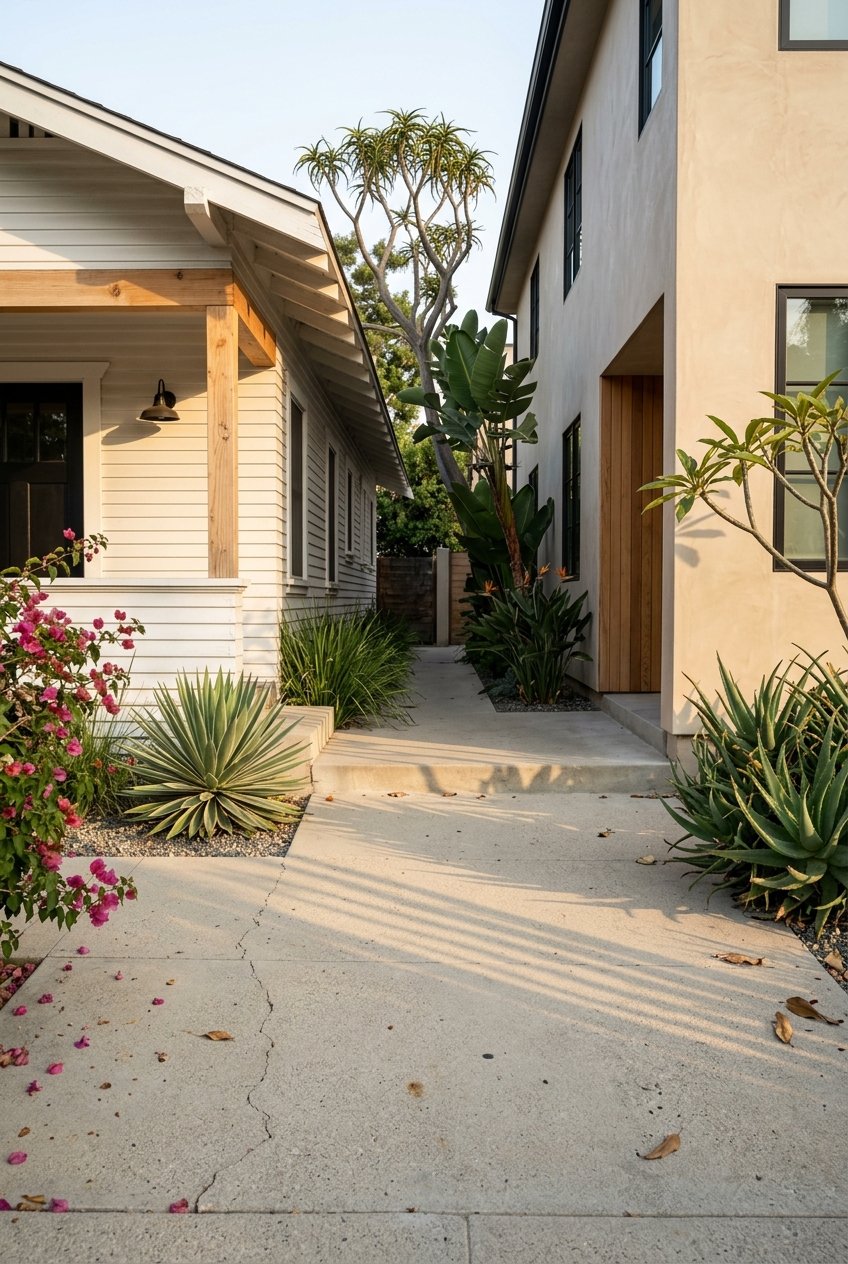
What makes one Venice block feel instantly more intentional than another? For many design-minded buyers, the answer is the walk streets. These pedestrian-oriented blocks offer a different kind of living experience, one shaped by architecture, scale, and how homes meet the public realm. If you are trying to understand why they stand out in Venice, this guide will help you see both the design appeal and the practical tradeoffs. Let’s dive in.
Walk streets have a distinct Venice logic
Venice was founded by Abbot Kinney in 1905 as a beachfront resort and was later renamed Venice in 1911. City planning documents describe its early form as a pedestrian-oriented neighborhood built around canals, walk streets, and bungalows. That origin still matters today because the walk streets were not added as a novelty later on. They are part of the neighborhood’s original planning DNA.
The City of Los Angeles treats walk streets as their own street type in the Venice Coastal Zone Specific Plan. These streets are planned for pedestrian use, with vehicle access to lots routed from alleys or other streets instead. On the walk street itself, vehicular access is restricted to emergency vehicles. That single planning choice changes how the block feels from the moment you arrive.
In practical terms, you are not looking at a standard residential street with cars, curb cuts, and garage presence dominating the frontage. You are looking at a block where the pedestrian path comes first. For buyers who care about design, that difference often reads immediately.
Design-minded buyers notice the scale first
One of the biggest draws of Venice walk streets is scale. City policy describes Venice as pedestrian oriented in scale, and the walk streets express that idea clearly. The homes tend to meet a wide concrete walkway rather than a car-dominated street edge, which creates a more intimate visual rhythm.
That intimacy is part of the appeal. Instead of a block organized around driveways and parked cars, you see entries, porches, windows, gardens, and planting beds doing more of the visual work. The result is a setting that feels composed at the human level.
For a buyer with an architecture and design lens, this often feels more legible and more thoughtful than a typical drive street. The spacing, frontage, and orientation create a stronger sense of identity. Venice has many compelling pockets, but the walk streets are among the clearest examples of form shaping experience.
Historic architecture adds depth
The walk streets also attract buyers because they sit within historic districts with a strong concentration of early homes. SurveyLA identifies the North Venice Walk Streets Historic District as a 448-property district, with most original residences dating from the 1900s through the 1920s. Those homes are typically Craftsman or Victorian vernacular.
SurveyLA also identifies the Milwood Venice Walk Streets Historic District, which contains 471 properties. Its homes are mostly one- and two-story single-family residences from the teens through the 1930s, largely Craftsman, with Period Revival and modest vernacular examples as well. For buyers who value older housing stock, that architectural continuity can be a major reason to focus on these streets.
Venice more broadly includes styles ranging from Craftsman and Shingle to Prairie, Streamline, late modern, and postmodern, according to the City’s draft policy document. That means the area can appeal both to preservation-minded buyers and to those who appreciate contemporary design. On the walk streets, though, the earlier fabric and the historic orientation of the homes often become the main story.
The frontage feels more residential
The Venice Coastal Zone Specific Plan does more than limit vehicles. It also reinforces a pedestrian-scaled frontage. New facades are expected to complement nearby structures, use articulation and variation, and place entrances and frequent windows toward the walk street.
The plan also encourages features like front porches, bays, and balconies. Gardens and patios in the public right-of-way are preserved as a transitional zone between the pedestrian path and private homes, while fences and hedges are kept low. For a design-aware buyer, those details matter because they shape how a block feels day to day.
This is one reason walk-street living can feel more curated than conventional beach-neighborhood housing. The public and private edges are handled with more care, and the architecture has a chance to address people rather than cars. If you respond strongly to frontage, proportion, and the sequence from path to porch to entry, this setting can be especially compelling.
Walk streets offer a different Venice experience
Venice has several well-known living environments, and each one offers something different. Walk streets tend to appeal to buyers who want access to the larger Venice coastal setting without living in the most visitor-heavy environments. That balance is part of their draw.
Compared with drive streets
SurveyLA notes that the Milwood walk streets differ from nearby drive streets in their physical makeup. Walk streets are defined by narrow concrete sidewalks, walls, fences, mature vegetation, and planting beds, while drive streets include curbs, sidewalks, and landscaped parkways.
That may sound subtle on paper, but it creates a noticeably different experience in person. Because vehicle access is routed away from the walk street itself, the block reads as less car-dominant. Buyers who care about atmosphere as much as square footage often see that as a meaningful distinction.
Compared with the Venice Canals
The canals offer water views, pedestrian bridges, and a setting shaped by the original canal network. The Local Coastal Program describes the canals and lagoon as places for strolling, sightseeing, birdwatching, and non-motorized boating.
Walk streets offer a different kind of pedestrian scale. Instead of water as the organizing feature, the architecture and frontage relationships take the lead. If you are deciding between the two, it often comes down to whether you are drawn more to waterfront character or to a promenade-like residential streetscape.
Compared with Ocean Front Walk
Ocean Front Walk is one of the most recognized pedestrian corridors in Venice. The Local Coastal Program identifies it as a continuous public pedestrian walkway, and a City recreation document estimates roughly 28,000 to 30,000 daily visitors to the Venice Beach Boardwalk and adjacent Recreation and Parks property.
That context helps explain why some buyers look to the walk streets instead. You are still connected to Venice’s beach environment, but the residential setting is very different from one of the area’s most active public corridors. For many design-minded buyers, that more residential setting is central to the appeal.
Location still plays a big role
Part of what makes the walk streets attractive is that they are not isolated from the rest of Venice. The Local Coastal Program describes Ocean Front Walk, the beach, the canals, and the walkways and waterways as part of Venice’s recreation and visitor-serving landscape. In other words, the walk streets exist within a much broader coastal network.
Notable walk-street clusters include North Venice blocks near Speedway and Main Street, the Milwood blocks of Nowita Place, Marco Place, Amoroso Place, and Crescent Place, plus additional beach-adjacent streets near Pacific Avenue, Ocean Front Walk, and Main Street. For buyers, that means the design appeal is paired with a location that still feels very much tied to the larger identity of Venice.
This combination matters. A home can be architecturally compelling, but if its surrounding environment does not support the lifestyle you want, the fit may not be right. The walk streets often attract buyers who want both strong design character and close connection to the coastal fabric of Venice.
Practical tradeoffs matter before you buy
As appealing as the walk streets are, they come with practical considerations that deserve real attention. This is especially true if you are comparing them with more conventional streets in Venice or elsewhere on the Westside. Good buying decisions usually come from understanding both the romance and the realities.
Parking and access
Because walk streets are designed for pedestrian use, vehicle access to homes typically comes from alleys or other streets. That can affect how you think about parking, guest arrival, moving logistics, and day-to-day convenience. It is important to understand exactly how a specific property functions before you commit.
Deliveries can also feel different here than on a standard drive street. The layout may be part of the charm, but it can also require a bit more planning. For some buyers that is a minor tradeoff, while for others it is a major factor.
Remodeling and design changes
If you are considering updates, context matters. The Specific Plan says new work should complement nearby structures, and SurveyLA identifies major walk-street areas as historic districts with early 20th-century fabric.
That does not mean change is impossible. It does mean design decisions often need to respond more carefully to scale, materials, and frontage relationships than they might on a newer inland street. Buyers who want to renovate should go in with a clear understanding of that design context from the start.
Privacy and outdoor space
The same features that make walk streets charming can also shape privacy differently. Gardens, patios, landscaping, decks, and fences may exist in the public right-of-way under revocable permit rules, and the plan preserves these low-scale transitional elements between the path and the home.
That can create a beautiful layered frontage, but it also means privacy is often achieved through design rather than full separation. If you like a more open relationship between the home and the pedestrian environment, that may feel ideal. If you want a stronger sense of enclosure, you will want to evaluate each property carefully.
Why these streets keep attracting design-focused buyers
At a high level, Venice walk streets combine three things that are hard to replicate. First, they preserve a pedestrian form that is part of Venice’s original identity. Second, they offer early beach-town architecture and a historic streetscape that still reads clearly today. Third, they place you close to the larger coastal environment that makes Venice so distinctive.
For buyers who see homes through a design lens, that combination can be hard to ignore. You are not just buying square footage or proximity to the beach. You are buying into a specific relationship between architecture, movement, and neighborhood form.
That is why walk streets tend to resonate with people who care deeply about how a place feels, not just what it includes on paper. If you are evaluating Venice with an eye for design, they deserve a closer look.
If you are considering a Venice walk-street home, it helps to work with someone who can evaluate both the architecture and the practical tradeoffs with you. John Iglar brings a design-oriented, detail-focused approach to helping buyers and sellers navigate Los Angeles homes with clarity and confidence.
FAQs
What are Venice walk streets in Los Angeles?
- Venice walk streets are pedestrian-oriented residential streets recognized by the City of Los Angeles as a separate street type, where vehicle access to homes generally comes from alleys or other streets and the walk street itself is restricted to emergency vehicles.
Why do design-minded buyers like Venice walk streets?
- Design-minded buyers are often drawn to the pedestrian scale, historic architecture, frontage details like porches and gardens, and the stronger sense of visual identity compared with more car-oriented residential blocks.
Where are the main Venice walk-street areas?
- Notable clusters include North Venice blocks near Speedway and Main Street, the Milwood blocks of Nowita Place, Marco Place, Amoroso Place, and Crescent Place, plus additional beach-adjacent streets near Pacific Avenue, Ocean Front Walk, and Main Street.
How are Venice walk streets different from the Venice Canals?
- Venice walk streets emphasize architecture, porches, gardens, and pedestrian frontage, while the Venice Canals are shaped by water views, bridges, and the original canal network.
What should buyers consider before buying on a Venice walk street?
- Buyers should look closely at parking and alley access, delivery and move-in logistics, privacy at the frontage, and how any future remodeling may need to respond to the surrounding historic and design context.